Ever taken a road trip where driving feels less like rolling on pavement and more like skimming right over open water? If not, let me tell you about the Overseas Highway in Florida.
Along the way, the Overseas Highway guides you through classic island communities. They are –
- Key Largo, the diving and water lovers’ gateway
- Islamorada, steeped in sportfishing lore and laid-back arts
- Marathon, home to tranquil marinas and coastal stops
- Bahia Honda State Park, boasting some of the most postcard-perfect beaches in Florida
Can you drive from Miami to Key West?
You may drive from Miami to Key West. The route follows U.S. 1 south from Miami into the Florida Keys before continuing to Key West. The travel is around 160 miles and takes about three hours without traffic or pauses, but you should allow much more time if you intend to explore along the way.
If you tear down Highway 1 without stopping anywhere from Miami to the Keys, you miss the entire spirit of the Florida Keys. The Keys aren’t meant to be rushed; they operate on island time, where locals chat over freshly battered fish, prehistoric tarpon snap sardines from your hand, and roadside kitsch sits proudly next to fascinating early-twentieth-century engineering.
If you want the ultimate Florida road trip experience, set aside a full day or a couple of days to enjoy. Here is your complete mile-by-mile guide to the 17 best stops between Miami and Key West.
Miami to Key West Road Trip Route
Your Key West road trip generally starts with Miami. Miami is the boarding point. Check all the entire itinerary before you go and plan it. Now you are in Miami.
- Miami to Key Largo
- Key Largo to Islamorada
- Islamorada to Marathon
- Marathon on the Overseas Highway
Miami to Key West Road Trip Snapshot: What You Need to Know Before You Go
- Starting Point: Downtown Miami / Miami Beach
- Ending Point: Mile Marker 0, Key West
- Distance: ~165 miles
- Driving Time: 3.5 to 4 hours without traffic (plan for a full 8 to 10 hours with stops)
- Best Time to Go: December through May offers warm, dry days and gentle ocean breezes. Summer brings higher humidity and afternoon pop-up showers, but fewer crowds.
- Navigation Tip: In the Keys, nobody uses standard street addresses. Everything revolves around Mile Markers (MM), counting down from MM 126 just south of Florida City all the way down to MM 0 in Key West. If someone tells you a diner is at “Bayside MM 82,” you’ll know it’s on the right-hand (Gulf) side of the highway heading south.
If you didn’t plan your Florida itinerary, read our article: Travel Guide to Florida
Best Stops on the Miami to Key West Drive
Stop 1: Macondo Coffee Roasters in Miami
What do you say? Every legendary road trip starts with coffee, right? I did the same. Before moving to the turnpike traffic, duck into Macondo Coffee Roasters.
After entering Macondo, it feels like slipping into an artisan café in Medellín. The space is cozy, decorated with rustic wooden tables, hanging plants, and burlap coffee sacks. The specialty here is single-origin Colombian beans roasted to bring out smooth, chocolatey notes.
Order a classic cortado or an iced pour-over, pair it with a warm pan de bono (traditional cheese bread) or an empanada, and settle in.
Now it’s time to start the journey. Check the car’s tire pressure and stash your sunglasses on the dash. Once you leave Miami’s city limits, the landscape changes fast.
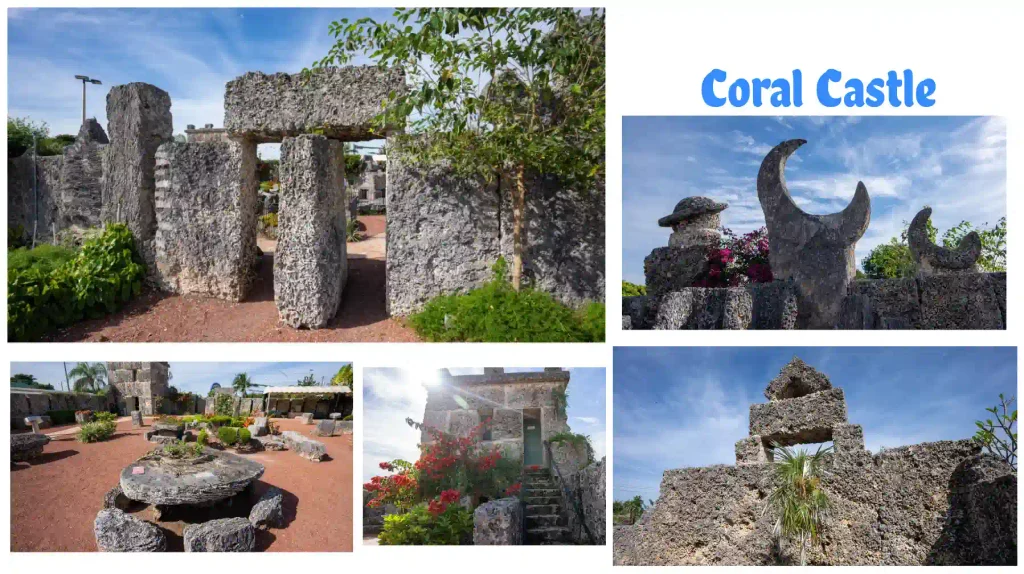
Stop 2: Coral Castle in Homestead
About 45 minutes south of downtown Miami sits one of the weirdest and most captivating roadside wonders in North America: Coral Castle.
Between 1923 and 1951, a five-foot-tall, 100-pound Latvian immigrant named Edward Leedskalnin single-handedly quarried, shaped, and hoisted over 1,100 tons of dense oolite limestone rock. He claimed he built the monumental structure as a shrine to his lost love, Agnes Scuffs, who canceled their wedding just a day before the ceremony.
What leaves structural engineers scratching their heads is how he pulled it off. Working under cover of night by lantern light, with only rudimentary handmade pulleys, tripods, and counterweights, Ed moved megaliths larger than those used in Stonehenge.
When you take the 45-minute guided walking tour, you’ll see a multi-ton stone gate balanced so exquisitely that you can push it open with the touch of a child’s finger, stone rocking chairs, and an enormous stone sundial that still keeps accurate time. It feels surreal, touching on architectural genius and eccentric obsession in equal measure.
Stop 3: Robert Is Here in Florida City
Just 15 minutes further south, right at the edge of the Everglades in Florida City, you’ll spot a sprawling open air fruit market that began back in 1959.
The story goes that six-year-old Robert was tasked with selling his family’s surplus cucumbers on the road. The first day was a total flop—no one stopped. The next day, his father painted two massive signs on cardboard that read: “ROBERT IS HERE.” By noon, Robert had sold every cucumber, and an iconic American agricultural staple was born.
Here you’ll find fresh produce you might never have seen before:
- Mamey sapote (sweet, creamy, reminiscent of pumpkin and sweet potato)
- Monstera deliciosa fruit (tastes like a wild mashup of banana, pineapple, and mango)
- Dragonfruit, lychees, jackfruit, and passion fruit
The real rite of passage here is ordering one of their ultra-thick, hand-churned fruit milkshakes. Go for a strawberry-key lime swirl, black sapote, or passion fruit. While waiting for your order, go out to the backyard farm area to visit the rescue emus, goats, and tortoises. It is the quintessential old-school Florida farm stand. Here, tortoises are so famous. The interesting thing here is that there are some tortoise hospitals nearby.
Stop 4: Card Sound Road and Key Largo
Key Largo is an island. After leaving Florida City, Highway 1 narrows down as it cuts through the marshy expanse known as the “Stretch.” If there’s heavy weekend traffic or roadwork on the main highway, detour via County Road 905A (Card Sound Road).
Card Sound takes you over the toll bridge at Card Sound, serving up sweeping panoramas over the saltwater mangroves and open bays. Keep your eyes on the shallow waters along the road banks—you can frequently spot blue herons, snowy egrets, and the occasional sunbathing alligator.
Rejoining Highway 1 deposits you safely onto Key Largo, the longest and northernmost island of the Florida Keys chain.
Stop 5: Mrs. Mac’s Kitchen in Key Largo
If you’re ready for real Keys comfort food, pull over at Mrs. Mac’s Kitchen around Mile Marker 99. Opened in 1976, it holds the title of the oldest operating restaurant in Key Largo.
The place screams maritime character: license plates gifted by travelers from all over the globe cover the walls, bumper stickers hide the wooden booths, and the air smells of sizzling garlic and freshly baked pastry.
A few things here are non-negotiable:
- The Key Lime Freeze: A tart, sweet, icy slush that instantly cuts through humid afternoon heat.
- Fresh Catch of the Day: Get it blackened or “Key Largo style” (sautéed with fresh tomatoes, yellow onions, and melted mozzarella).
- Their Original Key Lime Pie: Smooth, creamy, custard-like filling resting on a buttery graham cracker crust with a dollop of real whipped cream.
Stop 6: Rain Barrel Artisan Village and Betsy the Lobster
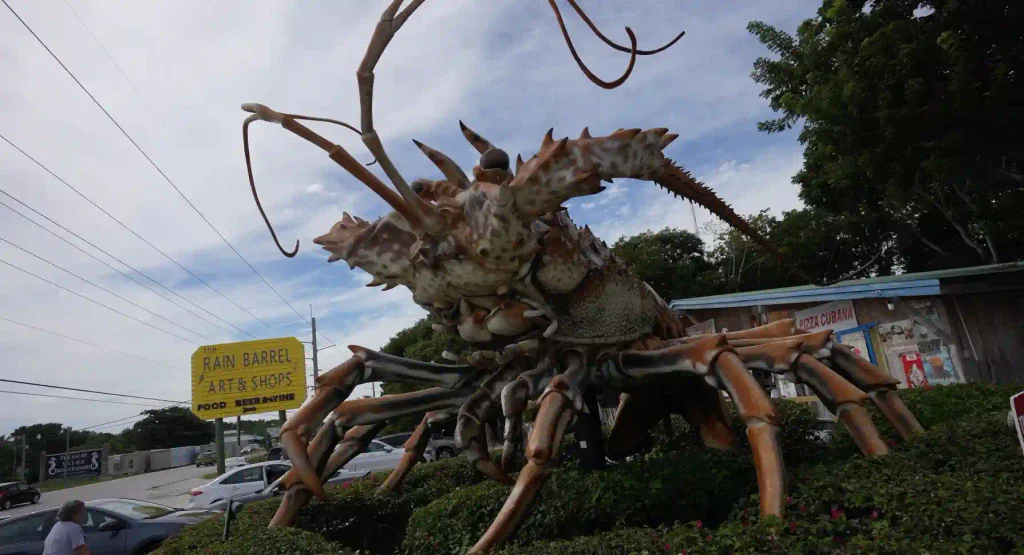
As you cruise south into Islamorada (around MM 86.7), you won’t miss Betsy the Lobster. Betsy is a 30-foot-tall, 40-foot-long fiberglass sculpture modeled after the Caribbean spiny lobster (which lacks the big crushing claws of Maine lobsters). Betsy is the queen of Florida Keys roadside photo ops. Park your car and walk up to the massive painted antennae and click some selfies.
Behind Betsy lies a village called – Rain Barrel Artisan Village, a shaded courtyard wrapped in tropical foliage. Wooden boardwalks guide you through working art studios where local painters, sculptors, and glassblowers sell handmade jewelry, custom driftwood carvings, and Florida pottery.
Stop 7: History of Diving Museum in Islamorada
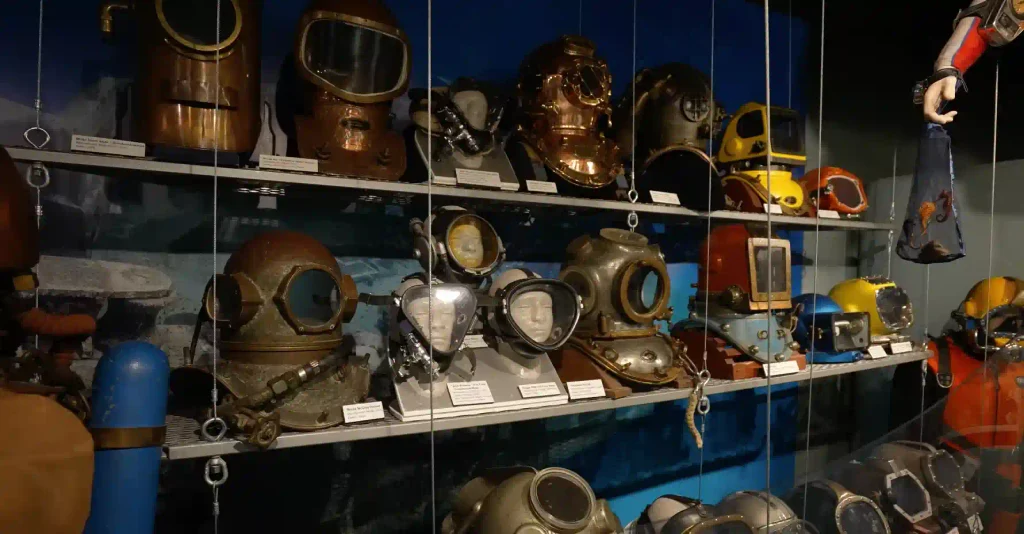
The History of Diving Museum is a world-class cultural treasure tucked away inconspicuously along the highway at MM 83.
Joe and Sally Bauer, two retired doctors and diving historians, opened this museum with one of the largest collections of historical diving gear in the world. It shows how people have explored underwater for thousands of years.
Highlights include:
- The Parade of Nations: An astonishing room lined with heavy brass, copper, and bronze diving helmets sourced from over 30 countries.
- Interactive breath-holding challenge: See how long you can hold your breath compared to legendary sponge divers and free divers.
- Historic diving gear: Ponderously heavy steel armored suits designed for early salvage operations that make you feel like you’re staring at vintage sci-fi astronaut gear.
- Pop culture oddities: Learn how engineers modified a standard double-hose diving regulator to capture the iconic mechanical breathing of Darth Vader in Star Wars.
It’s air-conditioned, remarkably curated, and gives you a deep appreciation for the maritime pioneers who charted the Florida reef tract.
Stop 8: Florida Keys Brewing Company
After a couple of minutes down the road in Islamorada’s vibrant Morada Way Arts & Cultural District, swing into the Florida Keys Brewing Company.
This is the Upper Keys’ first microbrewery, run by a husband-and-wife team whose love for brewing and vibrant art jumps out from every corner. The taproom is bright and kaleidoscopic, with bottle-cap mosaics lining the bar, while the sprawling outdoor beer garden is shaded by lush palms and strung with whimsical fairy lights.
Grab a tasting flight to sample their island-inspired creations:
- Iguana Bait: A light, thirst-quenching kolsch infused with sweet local hibiscus flowers.
- Runfish IPA: Citrus-forward, dry, and refreshing on a sun-drenched afternoon.
- Spearfish Stout: Dark and rich, brewed with roasted barley and hints of chocolate.
Grab a seat on the garden benches, listen to reggae chords bouncing over the speakers, and soak in the laid-back pace of island life.
Stop 9: Islamorada Hurricane Memorial
Just a short walk from the brewery along Highway 1 (MM 81.5) stands a solemn and historically vital monument: the Islamorada Hurricane Memorial.
This Hurricane memorial, carved from natural Florida coral limestone, commemorates the more than 400 World War 1 servicemen and local citizens who died on Labor Day, 1935. That Category 5 monster is still one of the three most powerful hurricanes to make landfall in the United States, with sustained winds of 185 mph and an 18-foot storm surge that washed away homesteads and destroyed Henry Flagler’s renowned Overseas Railroad.
Etched into the stone are the names of those lost, along with a bas-relief depicting the storm’s fury whipping across palm trees. Take ten quiet minutes to walk around the monument. It puts the harsh realities and resilience of early Florida Keys settlers into grounding perspective.
Stop 10: Bass Pro Shops Worldwide Sportsman and the Pilar
Directly across the highway on the bayside sits the massive Bass Pro Shops Worldwide Sportsman flagship store. Even if you aren’t shopping for salt-spray fishing gear, deep-sea reels, or polarized shades, it’s worth walking inside.
Anchored smack in the center of the massive showroom is the Pilar, a gleaming, authentic 1930s sister wooden motor yacht built to the exact blueprint of Ernest Hemingway’s famed fishing vessel.
Visitors can climb right aboard the wooden deck, walk into the wheelhouse, and inspect vintage photos, black-and-white logs, and historical plaques detailing Hemingway’s wild swordfishing expeditions off Cuba and the Keys. Behind the store, you’ll also find a peaceful marina basin that overlooks the Florida Bay.
Stop 11: Robbie’s of Islamorada and the Giant Tarpon
If you ask locals to name the single most unforgettable, adrenaline-spiking stop on the entire drive, nine out of ten will immediately shout: Robbie’s of Islamorada (MM 77.5).
Robbie’s is a bustling maritime complex with boat charters, kayak rentals, open-air souvenir shacks, and a waterfront restaurant. But the headline event happens right out on the wooden docks: feeding wild tarpon.
Here’s the drill:
- Pay a few dollars for a dock pass and a plastic bucket loaded with dead herring.
- Put your sunglasses and phone securely in your pocket (they routinely get knocked into the drink).
- Walk out on the low wooden planks and watch the dark water below.
Swimming directly underneath your feet are dozens of “silver kings”—wild tarpon measuring between four and seven feet long and weighing up to 150 pounds.
When you kneel on the dock, dangle a herring by its tail a few inches above the surface. Suddenly, the water boils, an armored silver titan breaches with a resonant THWACK, flares its gills, and vacuums the fish straight out of your fingertips with sandpaper-like jaws.
Pro Tip: Guard your bucket fiercely. Squadrons of sly brown pelicans stand shoulder-to-shoulder on the dock pilings, just waiting to swipe your herring while you’re lining up a slow-motion video.
Stop 12: Keys Fisheries in Marathon
Crossing south over the Long Key Bridge brings you into the heart of the Middle Keys and the bustling fishing town of Marathon. By now, your stomach will be rumbling for lunch. Make a beeline for Keys Fisheries (MM 48.8).
Keys Fisheries is a no-frills, open-air working marina counter where you order at the window and pick up your paper basket when they call out your name.
Their claim to fame? The Lobster Reuben.
They take heaps of tender, sweet Florida spiny lobster tail meat, pile it onto toasted rye bread, smother it with Swiss cheese, tangy sauerkraut, and homemade Thousand Island dressing, and grill it until it’s golden and decadent. It’s rich, messy, and famous across the state.
Be sure to also grab a cup of their house-smoked fish dip, served alongside hot pickled jalapeños and crispy saltines. Take your tray upstairs to the open deck, watch commercial stone crab boats unload their daily haul, and soak in the salty ocean breeze.
Stop 13: The Turtle Hospital in Marathon
Just a couple of miles south in Marathon sits one of the most heartwarming conservation facilities on the continent: The Turtle Hospital (MM 48.5).
Housed inside a converted 1950s roadside motel, this non-profit veterinary hospital opened its doors in 1986. Its sole mission is to rescue, rehabilitate, and release sick and injured sea turtles back into the open ocean.
Book a 90-minute educational guided tour to go behind the scenes:
- Meet green, loggerhead, hawksbill, and Kemp’s ridley sea turtles recovering from boat strikes, plastic ingestion, or fishing line entanglements.
- Tour the sterile operating rooms and medical treatment tanks.
- Visit the large tidal rehabilitation pools where recovering sea turtles learn to swim and dive again.
If you happen to be passing through when they’re releasing a fully healed turtle back into the surf on Sombrero Beach, joining the cheering crowd of locals is an emotional, unforgettable experience.
Stop 14: Giant Shark and Manatee in Marathon
As you near the western edge of Marathon, keep an eye out for classic American road trip kitsch. Outside a local souvenir and marine outlet, you’ll spot giant fiberglass sea creatures, including a massive Great White Shark head with its jaws gaping wide and a friendly life-sized Florida manatee statue.
Stop 15: Seven Mile Bridge and Fred the Tree
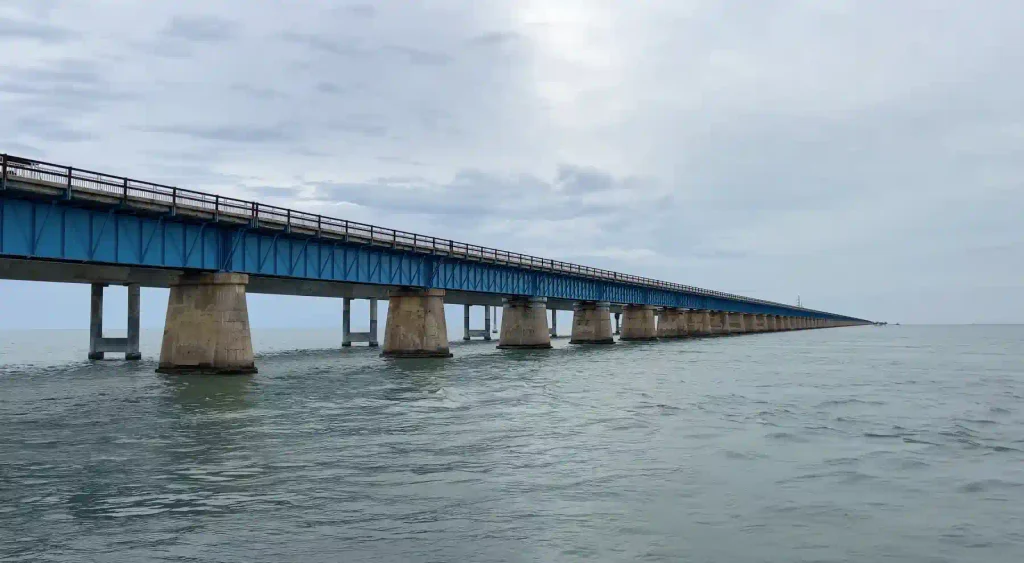
This is the crowning jewel of the Overseas Highway: the world-famous Seven Mile Bridge.
Stretching across 35,862 feet of open, emerald-tinted water, driving over the bridge feels like taking off in an airplane skimming right above the sea. To your right stretches the Gulf of Mexico; to your left, the vast Atlantic.
Running parallel to the modern concrete highway is the historic Old Seven Mile Bridge (originally Henry Flagler’s railway viaduct, built between 1909 and 1912). As you drive over the modern span, look closely at the rusted iron spans of the old bridge. Right around the middle, sprouting stubbornly out of the crumbling road deck, stands Fred the Tree.
Fred is a hardy Australian pine whose seeds were deposited on the bridge by a passing bird or hurricane wind. Despite having zero soil, enduring relentless tropical sun, and surviving blistering salt spray, Fred has flourished for decades. Locals decorate Fred with lights for Christmas, making him a symbol of Keys tenacity.
Right after you finish crossing the modern bridge, pull into the recreation parking lot on the right. You can walk, skate, or bicycle out onto the newly restored 2.2-mile section of the historic pedestrian bridge, lean against the railings, watch stingrays glide through the clear water below, and snap photos of the jaw-dropping ocean horizon.
Stop 16: Bahia Honda State Park
Just a five-minute drive past Seven Mile Bridge brings you to Bahia Honda State Park (MM 37). Widely considered the most scenic natural park in the entire island chain, this is where you want to spend an hour strolling sandy coastlines.
Unlike much of the Keys, which are ringed with dense mangrove forests or rocky limestone shelves, Bahia Honda boasts natural white sand beaches gently washed by sparkling, turquoise water.
The main architectural spectacle here is the Old Bahia Honda Railroad Bridge. Take the short, gently sloping asphalt trail from the parking lot up to the elevated observation section of the abandoned trestle.
From this vantage point, you’re perched dozens of feet above the water looking down into the Bahia Honda Channel. The water is so transparent you can clearly spot nurse sharks, rays, and giant barracuda cruising against the current. Looking back, you get an iconic view of the bridge’s abruptly cut span standing dramatically against the azure sky.
Stop 17: Big Pine Key and the Key Deer Refuge
Leaving Bahia Honda, your next major island is Big Pine Key (MM 30–33). This quiet, pine-forested island is home to the National Key Deer Refuge.
Key deer are an endangered subspecies of white-tailed deer found only in the Lower Florida Keys. Isolated from the mainland thousands of years ago, they evolved under island dwarfism: fully grown bucks stand barely 28 to 32 inches at the shoulder (roughly the size of a large golden retriever).
Turn off Highway 1 onto Key Deer Boulevard and make your way toward the Blue Hole, an old freshwater limestone quarry. Along the quiet residential streets and gravel paths, drive slowly (the speed limit drops strictly to protect them). You’ll frequently see these tiny, gentle creatures browsing on wild berry bushes or calmly standing along the shoulder of the road.
Remember: they are wild and federally protected, so never feed or approach them.
Final Stop: Mile Marker 0 in Key West
From Big Pine Key, you’ve got about 30 miles left. The final run through Cudjoe Key, Sugarloaf Key, and Boca Chica feels easy and breezy, as smaller bridges hopscotch over flats and sandbars until you finally roll onto the palm-fringed streets of Key West.
Make your way toward the intersection of Fleming Street and Whitehead Street. Standing on the corner, beside a white picket fence, is the holy grail of American road sign photography: MILE MARKER 0.
It marks the southern terminus of U.S. Route 1, which stretches over 2,369 miles all the way north to Fort Kent, Maine.
Once you’ve snapped your victory photo, kick off your driving shoes. Stroll down Duval Street, order a cold rum punch, and join the lively street performers and artists gathered at Mallory Square to watch the sun melt into the Gulf of Mexico. You’ve just completed one of the greatest road trips in the world.
Practical Tips for Your Overseas Highway Adventure
- Watch Your Speed Like a Hawk: Speed limits fluctuate between 45 and 55 mph on the highway and drop to 35 mph through small island business districts and Key Deer refuge zones. Highway patrol strictly enforces these limits.
- Download Offline Maps: While cellular coverage along the main road is generally reliable, navigation apps can drop when exploring state parks or side keys. Download an offline map of Monroe County just in case.
- Bring Cash for State Parks & Robbie’s: Entry to state parks like Bahia Honda and fish bucket purchases at Robbie’s are much faster when you have small bills on hand.
- Pack Reef-Safe Sunscreen: Florida law encourages mineral-based, reef-safe sunscreens (zinc oxide or titanium dioxide) to protect the sensitive coral reefs surrounding the Keys.
Safe travels, enjoy the drive, and remember: the journey down Highway 1 is just as memorable as the destination at the end of the road! And if you want more images like this, catch them on my Pinterest profile.